Strategies
AI SEO Strategies: 9 That Work, With Examples
By the SEO Using AI Editorial Team · Last updated · 4 min read
Quick answer
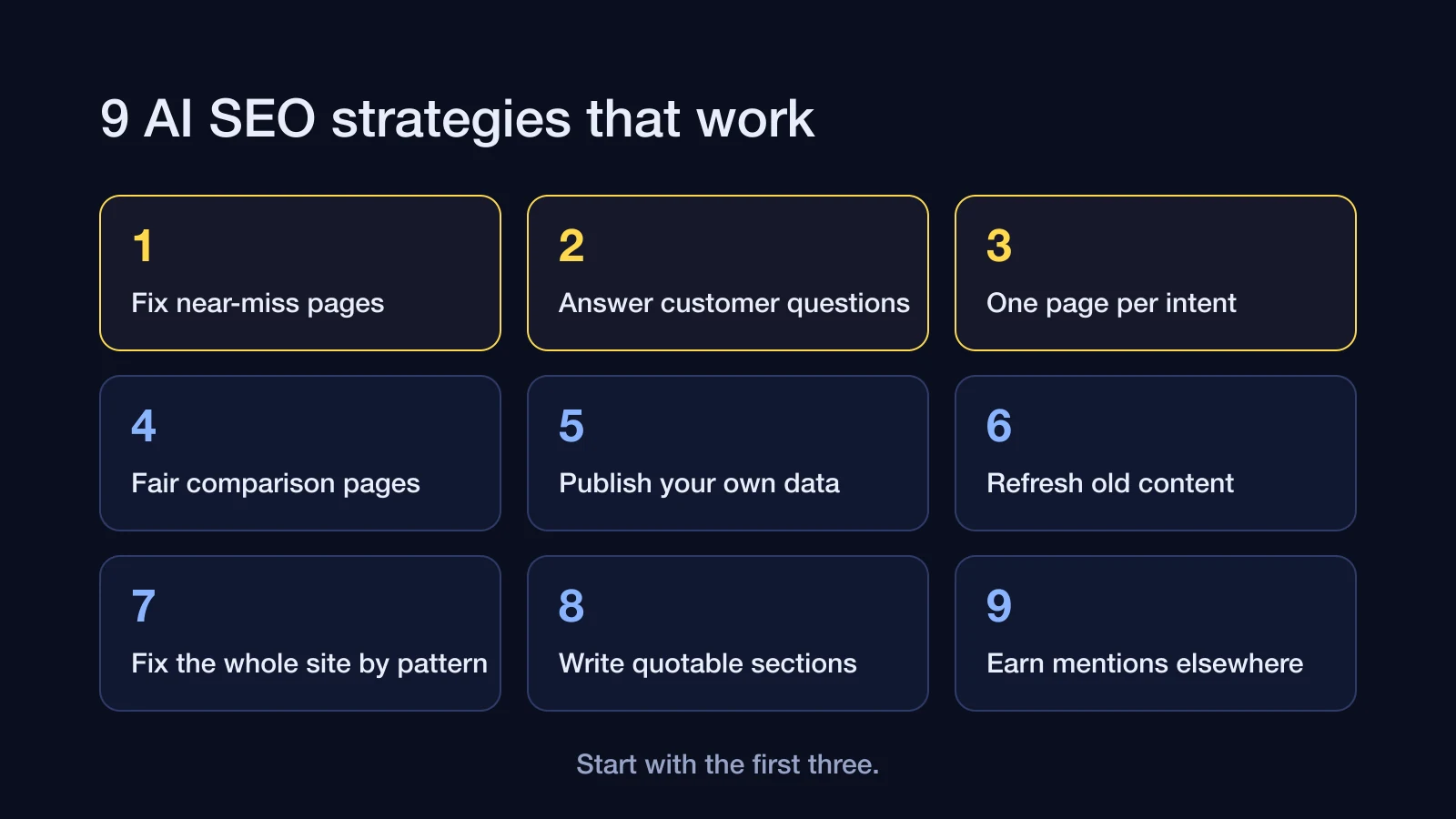
The AI SEO strategies that work best use AI for speed and a person for judgment. The most reliable ones are: improve pages that already almost rank, answer real customer questions, build one page per search intent, publish fair comparison pages, turn your own data into something worth linking to, refresh old content on a schedule, fix technical problems across the whole site, write sections AI tools can quote, and earn mentions on other websites.
What makes an AI SEO strategy work?
An AI SEO strategy works when AI handles the volume and a person supplies judgment and truth. Strategies that skip the human step produce the same generic pages everyone else can produce, and those do not rank for long.
Each strategy below states what to do, gives an example, and notes where AI helps.
1. How do you improve pages that almost rank?
You improve pages that almost rank by finding searches where you sit in positions 5 to 20 and strengthening those pages. Google already sees them as relevant, so the gap is small.
Example. A plumber's "water heater repair" page sits at position 11. The owner exports Search Console queries, asks AI which questions the page fails to answer, adds sections on cost, timing, and warning signs, and tightens the title.
Where AI helps. Sorting the export, spotting missing questions, drafting the new sections.
2. How do you turn customer questions into pages?
You turn customer questions into pages by writing down what customers ask on the phone and in email, then answering each one on your website. These are real searches, phrased the way real people phrase them.
Example. A dog groomer hears "how often should I groom a doodle?" every week. That becomes a page. AI drafts it from the groomer's own notes, and the groomer corrects the details.
Where AI helps. Expanding each question into related ones and drafting from your notes.
3. Why build one page per search intent?
Build one page per search intent because several pages chasing the same search compete with each other and all rank worse. One strong page beats five thin ones.
Example. A site has four blog posts about "email marketing tips". AI compares them, and the owner merges them into one guide and redirects the rest.
Where AI helps. Grouping keywords by intent and finding overlapping pages. See AI keyword research.
4. Why publish comparison pages?
Publish comparison pages because people search "this versus that" right before buying, and AI tools quote structured comparisons when asked for recommendations.
Example. An accounting software company publishes a fair comparison with its main competitor, including where the competitor is the better choice. A table carries the key differences.
Where AI helps. Structuring the comparison. A person must verify every claim about a competitor.
5. How do you turn your own data into links?
You turn your own data into links by publishing numbers only you have. Other websites link to original data because they cannot get it anywhere else.
Example. A moving company publishes average local move costs by home size from its own jobs, updated yearly. Local news and real estate blogs reference it.
Where AI helps. Analyzing your spreadsheet and drafting the write-up. See link building.
6. Why refresh old content on a schedule?
Refresh old content on a schedule because outdated pages lose rankings and are the first to be dropped from AI answers. A visible, honest "last updated" date helps readers and search engines.
Example. Every quarter, a site reviews its top twenty pages for old statistics, dead links, and stale screenshots.
Where AI helps. Flagging outdated facts and dead links across many pages at once.
7. How do you fix technical problems across a whole site?
You fix technical problems across a whole site by crawling every page and correcting issues by pattern, not one at a time. A missing title template might affect 300 pages with one fix.
Example. An online store finds that every category page shares one description. One template change fixes all of them.
Where AI helps. Reading the crawl, grouping problems by cause, and writing the fix. See technical SEO.
8. How do you write sections AI tools can quote?
You write sections AI tools can quote by making each one a complete answer: a question as the heading, the answer in the first sentence, and a named source for any number.
Example. "How much does a roof inspection cost?" followed immediately by the price range and what affects it, not by three sentences of introduction.
Where AI helps. Rewriting rambling sections into answer-first form. See the GEO guide.
9. How do you earn mentions on other websites?
You earn mentions on other websites by being useful to them: data, expert comments, tools, and partnerships. AI tools lean on third-party sources, so what others say about you shapes what AI says about you.
Example. A physiotherapist answers journalist requests about desk posture and gets quoted, with a link, in two regional outlets.
Where AI helps. Finding opportunities and drafting pitches. A person sends them and handles the relationship.
Which strategies should you start with?
Not sure the effort will pay off? Work it out with the formula in is AI SEO worth it. Start with strategies 1, 2, and 3. They need no budget, they build on what you already have, and they show results soonest. Add the others as the basics are in place. The workflow that ties them together is in how to use AI for SEO.
Frequently asked questions
What is the best AI SEO strategy for a new website?
The best AI SEO strategy for a new website is to target specific, low-competition questions your customers ask, publish one genuinely useful page for each, and link them to a main guide. Broad, popular keywords are held by established sites and come later.
Which AI SEO strategy gives the fastest results?
Improving pages that already rank between positions 5 and 20 usually gives the fastest results, because Google already considers those pages relevant. Small improvements can move them onto page one.
Are advanced AI SEO strategies risky?
The risky ones are those that remove human review, such as publishing AI pages in bulk. Advanced does not need to mean risky. Every strategy on this page keeps a person checking the output.