Start here
How to Use AI for SEO: A Step-by-Step Guide
By the SEO Using AI Editorial Team · Last updated · 5 min read
Quick answer
SEO using AI is the practice of using AI models such as ChatGPT, Claude, and Gemini to speed up search engine optimization work: keyword research, content briefs, drafting, on-page fixes, technical audits, and reporting. AI does the volume work. A human still chooses the strategy, verifies every fact, and adds the first-hand experience that search engines and readers reward.
What does SEO using AI actually mean?
SEO using AI means using AI models to do the repeatable parts of search engine optimization faster, while a person stays responsible for strategy, accuracy, and experience. In practice that covers six jobs: keyword research, content briefs, drafting, on-page optimization, technical audits, and reporting.
It does not mean pressing a button and publishing whatever comes out. Sites that do that get filtered by Google's spam systems and ignored by readers. The sites that win use AI to remove busywork so that more human time goes into the parts that are hard to fake.
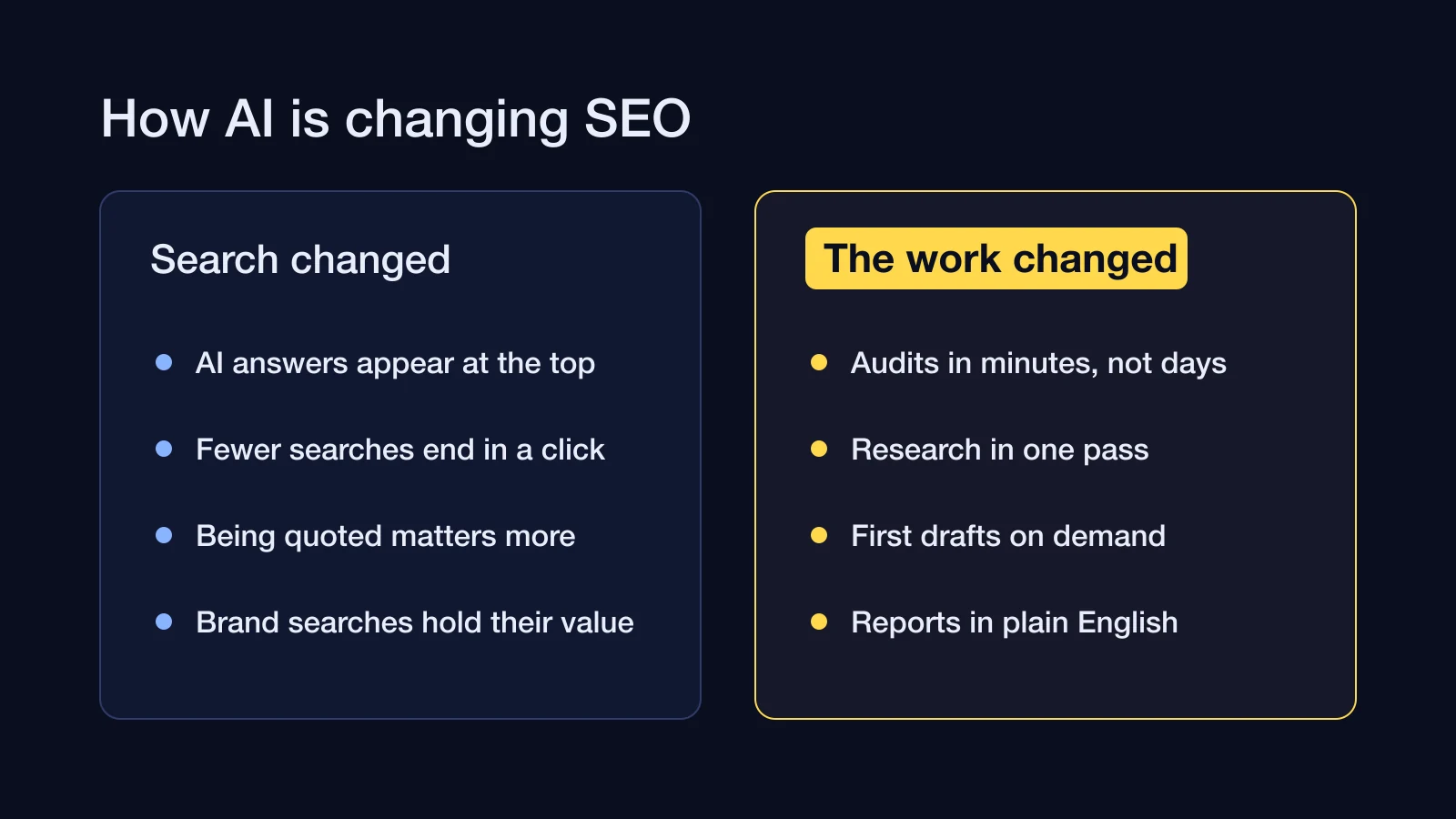
There is also a second meaning that matters in 2026. Search itself now runs on AI. Google shows AI Overviews, and people ask ChatGPT, Perplexity, and Claude questions they used to type into a search box. Doing SEO with AI now includes optimizing for those answer engines, a practice often called generative engine optimization.
Why does AI matter for SEO right now?
AI matters for SEO right now because it has changed both how SEO work gets done and how search results get clicked. Both shifts are measurable.
On the click side, a Pew Research Center study found that Google users clicked a traditional result in 8% of visits when an AI summary appeared, compared with 15% when it did not. Semrush's AI Overviews study tracked AI Overviews peaking near 25% of queries in mid 2025 before settling around 16% by November 2025.
The takeaway is practical. Informational clicks are harder to earn, so each page has to work harder: it must rank, earn the click, and be quotable enough to get cited inside the AI answer itself.
How do you use AI for SEO, step by step?
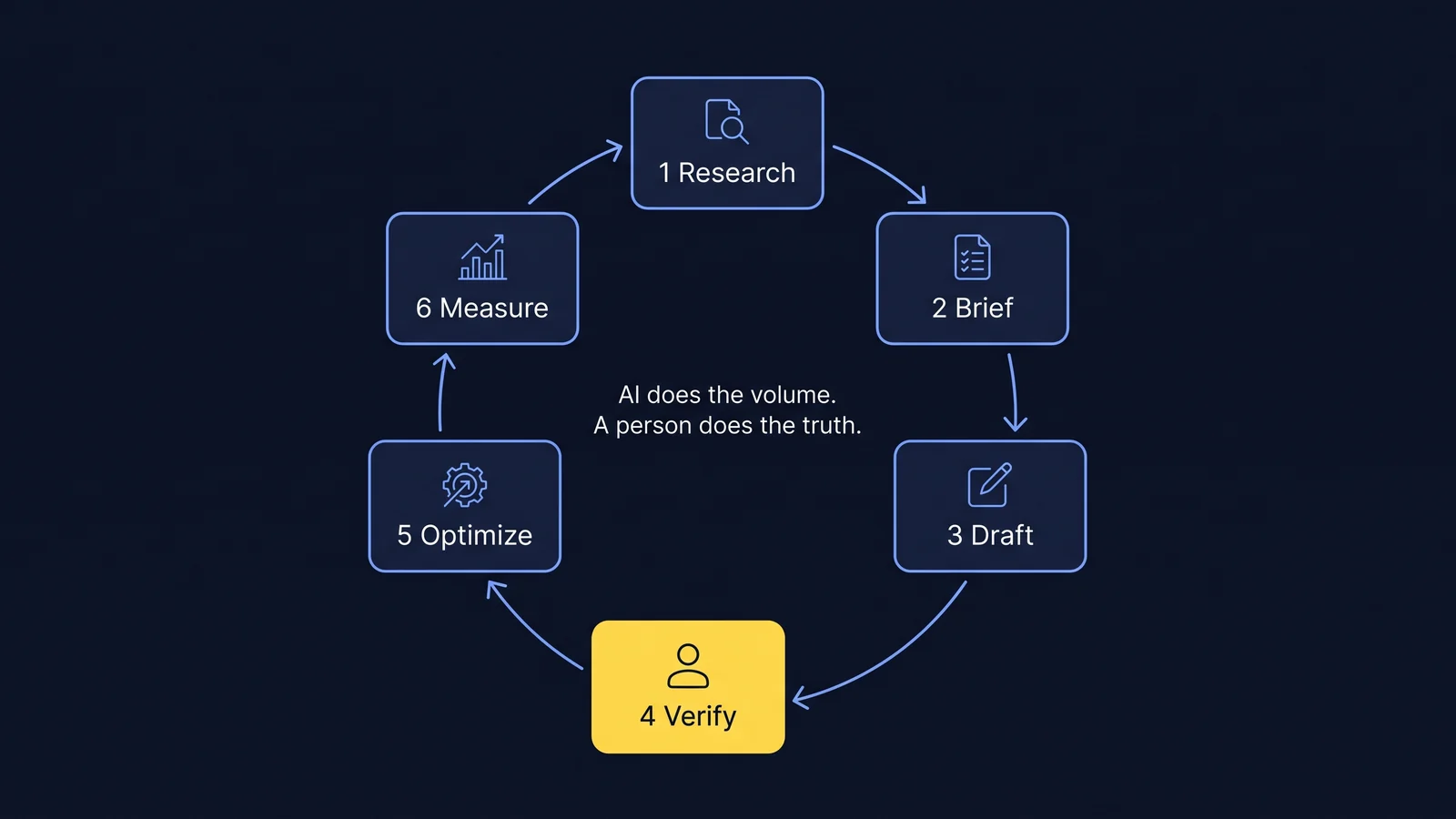
You use AI for SEO by running a six-step loop: research, brief, draft, verify, optimize, and measure. AI speeds up every step except verification, which stays human.
- Research. Give the model your niche, audience, and seed topics. Ask for question-style queries grouped by search intent. Then check volumes and difficulty in a real data source such as Google Search Console, Semrush, or Ahrefs. See AI keyword research.
- Brief. Paste the top-ranking page titles and headings into the model. Ask what they cover, what they miss, and what a better page would include. Turn that into an outline with question headings.
- Draft. Have the model draft section by section from the brief, with an answer-first sentence under every heading.
- Verify. Check every statistic, name, price, and claim against a primary source. Delete anything you cannot confirm. Add your own screenshots, results, and opinions.
- Optimize. Use AI to write title and meta description variants, suggest internal links, and generate schema markup. Preview your snippet with the SERP Snippet Preview.
- Measure. Track rankings and clicks in Search Console, and test whether AI engines mention you for your target prompts.
Which SEO tasks is AI good at, and which should stay human?
AI is good at SEO tasks that are high volume and pattern based. Tasks that depend on truth, judgment, or lived experience should stay human.
| Task | AI does well | Keep human |
|---|---|---|
| Keyword research | Expanding seeds, clustering by intent, finding question variants | Confirming volume and difficulty with real data |
| Content briefs | Summarizing competitors, spotting gaps, building outlines | Choosing the angle and what to leave out |
| Drafting | Structure, first drafts, rewrites for clarity | Facts, examples, opinions, experience |
| On-page | Titles, meta descriptions, alt text, schema, internal link ideas | Final wording on money pages |
| Technical | Explaining errors, writing redirects and regex, reading logs | Deciding what to ship and testing it |
| Reporting | Summarizing exports, drafting commentary | Deciding what to do next |
What are the biggest mistakes when doing SEO with AI?
The biggest mistake when doing SEO with AI is publishing unverified output at scale. Four mistakes cause most failures.
- Trusting invented data. General AI models do not have live keyword volumes. If a model gives you a search volume, treat it as a guess until a real tool confirms it.
- Publishing without editing. Google's spam policies target scaled content that adds little value. Unedited AI posts fit that description.
- Writing the same page as everyone else. If ten sites ask the same model the same question, they get the same article. Your experience is the only differentiator.
- Ignoring answer engines. A page can rank well and still never be quoted by an AI answer if its passages are vague and its facts are unsourced.
Does Google allow AI content?
Google allows AI content as long as it is helpful and made for people. Google's guidance on AI-generated content states that it rewards high-quality content however it is produced, and that using automation to manipulate rankings violates its spam policies.
The practical rule is simple. Ask whether the page would deserve to exist if AI had not made it cheap to produce. If the answer is yes, how you drafted it does not matter. If the answer is no, do not publish it.
What tools do you need to start?
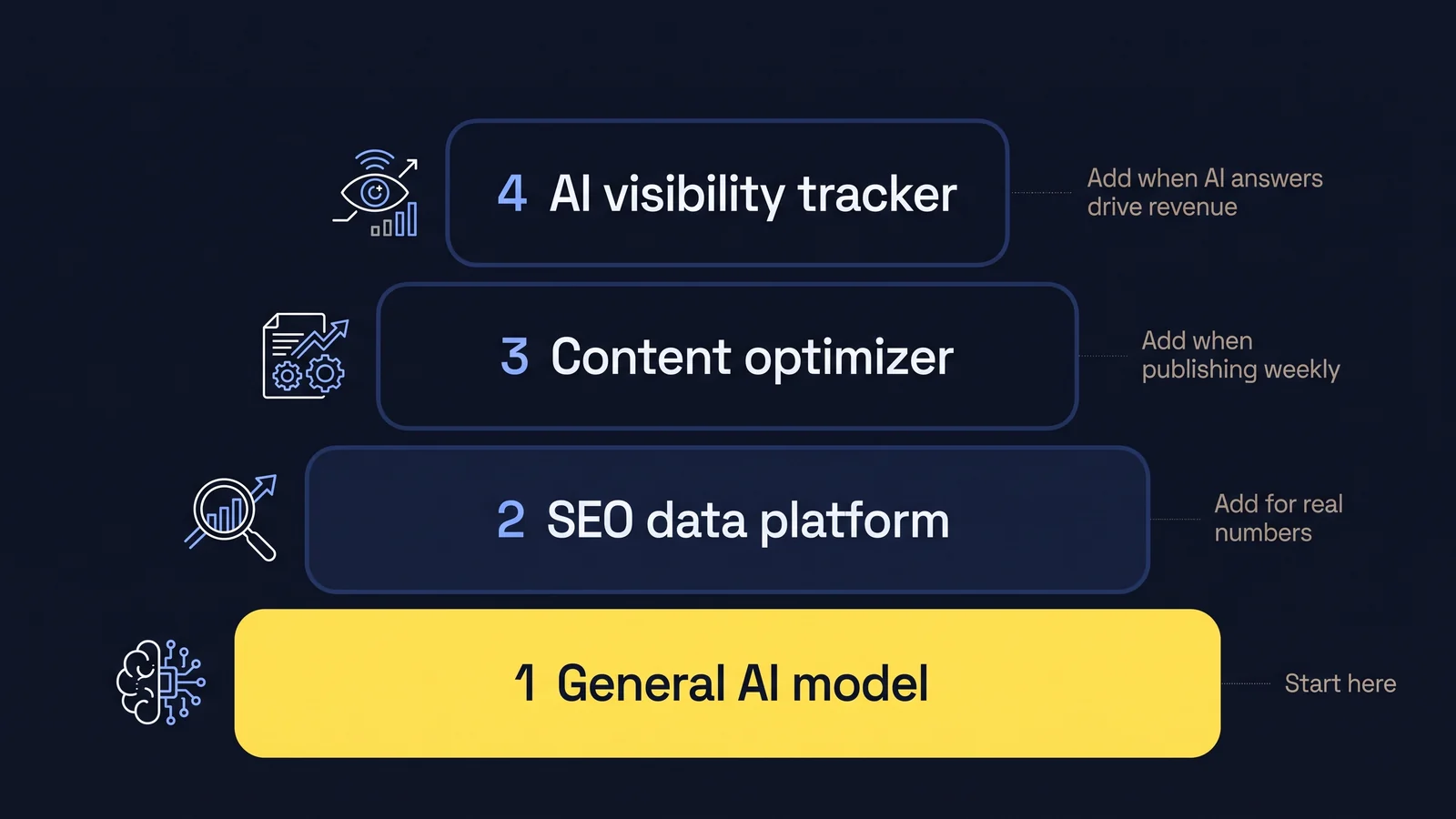
You need two tools to start doing SEO with AI: one general AI model and one source of real search data. A free setup is ChatGPT, Claude, or Gemini plus Google Search Console.
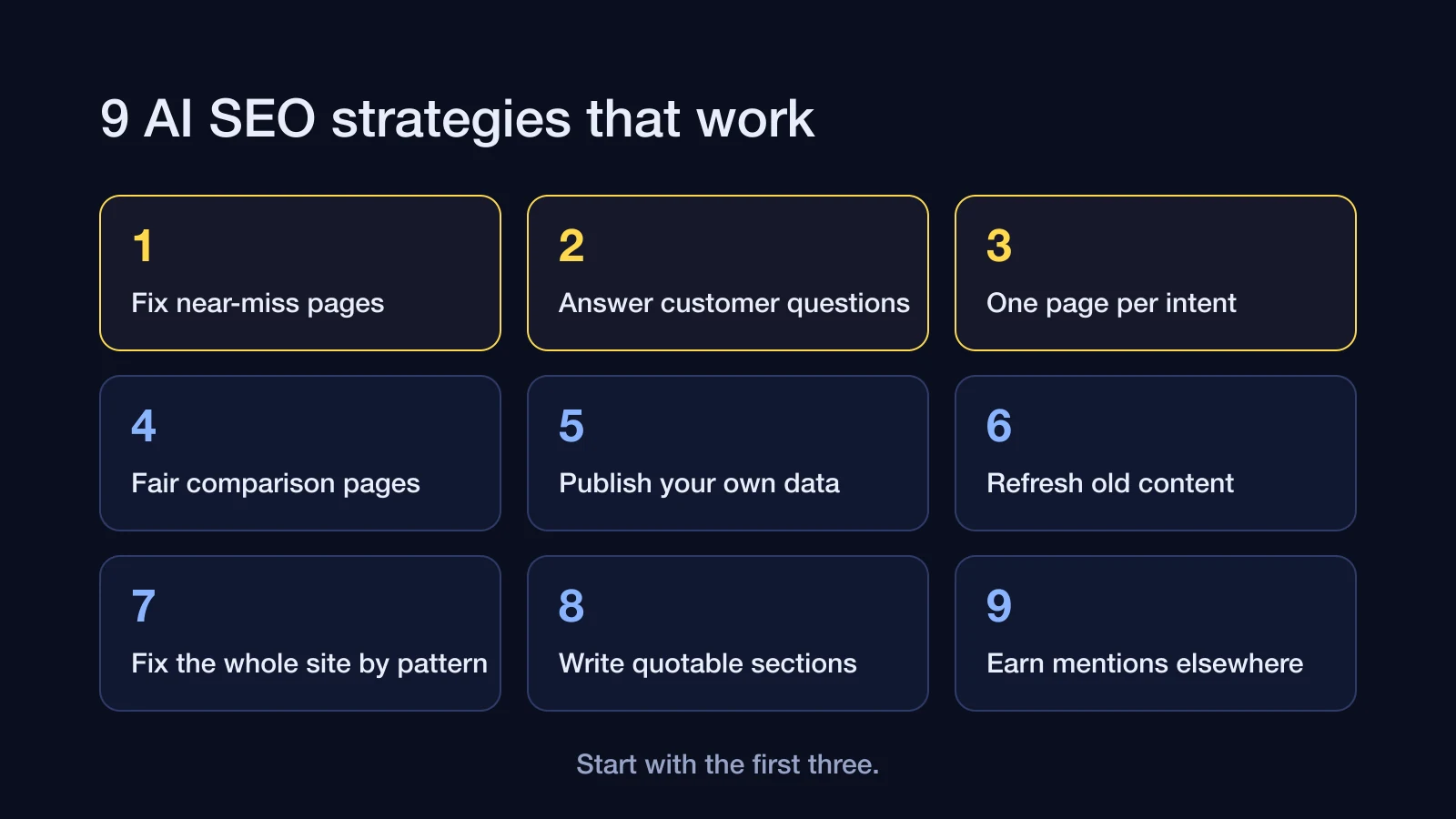
For the wider context, read how AI is changing SEO, then pick from these AI SEO strategies. If you want software to run whole tasks for you, see AI SEO agents.
When you are ready to spend money, add a keyword and competitor platform. Our AI SEO tools comparison explains which type of tool fits which job. You can also start with the free AI SEO Prompt Builder, which assembles structured prompts for the most common tasks.
Frequently asked questions
Can you do SEO using AI?
Yes. AI can handle most of the time-consuming parts of SEO, including keyword clustering, content briefs, first drafts, title and meta description variants, schema markup, and log or crawl analysis. It cannot replace real search data, fact-checking, or first-hand experience, so the best results come from AI plus a human editor.
Does Google penalize AI-generated content?
Google does not penalize content for being AI-generated. Google's guidance says it rewards helpful, original content however it is produced. What Google does penalize is scaled content abuse: publishing many pages of unedited, low-value content mainly to manipulate rankings, whether a human or an AI wrote it.
Which AI is best for SEO?
There is no single best AI for SEO. General models such as ChatGPT, Claude, and Gemini are strongest for research, briefs, drafting, and code. Dedicated platforms such as Semrush, Ahrefs, and Surfer add real keyword and ranking data that general models do not have. Most people get the best results by pairing one general model with one data tool.
Will AI replace SEO?
AI is changing SEO rather than replacing it. People still search, and AI answer engines still pull their answers from web pages. The job is shifting from writing more pages to publishing fewer, better pages that are easy for both Google and AI engines to quote.